
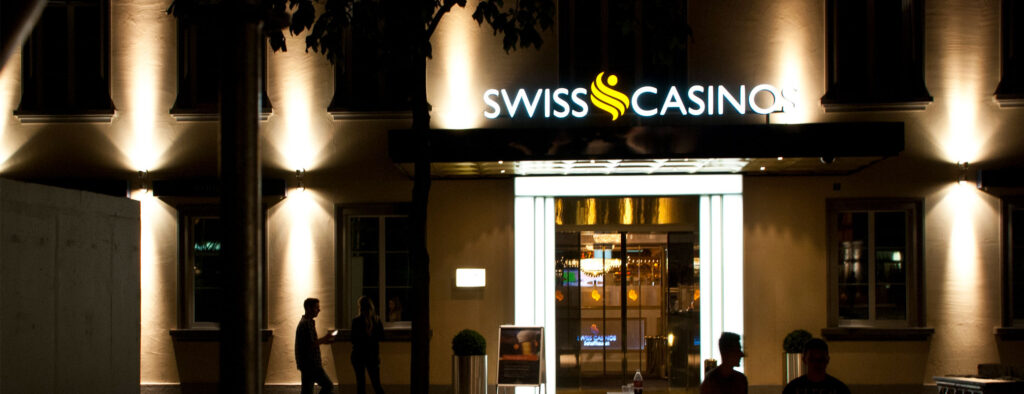
In March 2024, a highly coordinated group of 11 gamblers managed to take nearly $180,000 from Swiss Casinos Zurich using an elaborate baccarat cheating strategy, and for a short time, it appeared they might escape undetected.
Despite becoming the largest casino scam ever recorded in Switzerland, the story received little attention at the time.
It was mentioned mainly in the German-language documentary How to Cheat a Casino, released last summer.
The case gained wider recognition recently when the casino’s security team was honoured at the World Game Protection Conference for uncovering the plot.
Located in the heart of Zurich, just steps away from the luxury shopping boulevard Bahnhofstrasse, the casino appears relatively modest from the outside.
But inside, visitors are greeted by a more lavish environment, including a gold-lit escalator leading to the gaming floor on the second level.
On March 26, 2024, a group of Chinese nationals, later dubbed by prosecutors as “the Chinese Eleven”, arrived at the venue.
They deliberately avoided entering together.
Instead, they checked in separately throughout the day, sometimes alone and sometimes in pairs or small groups.
They blended in easily by playing roulette and blackjack and spending time socialising at the bar.
Later that evening, around 10 p.m., one of them requested a game of Punto Banco, the most common form of Baccarat.
The request raised no concerns; the game is particularly popular among Chinese players and dominates casinos in Macau.
At first, the group played casually and wagered small amounts.
They chatted with the dealer and maintained a relaxed atmosphere.
Then, unexpectedly, one player dramatically increased his bet, wagering up to 5,000 Swiss francs (about $6,500) per hand, far higher than his earlier bets of a few hundred francs.
He began winning consistently.
Soon, the other players followed his lead, raising their wagers whenever he did. A
After just a few more hands, the stakes dropped again.
Shortly afterwards, the group cashed out and left the casino with winnings totalling close to $180,000.
Large payouts automatically trigger a surveillance review at Swiss Casinos.
When the casino’s security team analysed the footage, something immediately seemed suspicious.
A deeper investigation followed, including a hand-by-hand breakdown of bets and timing.
The team also discovered that several members of the group had visited the casino multiple times in the weeks leading up to the incident, apparently scouting the location and studying camera positions.
The objective in baccarat is to predict which hand, the player’s or the banker’s, will finish with a value closest to nine.
Face cards and tens count as zero, aces count as one, and other cards retain their numerical value.
In some games of punto banco, once the cards are shuffled, a player is allowed to cut the deck by inserting a plastic card to create a break before the deck is placed into the dealing shoe.
During the Zurich game, the group convinced the dealer to hold the deck with his left hand during the cut, presenting the request as a harmless superstition, something not unusual among baccarat players.
In reality, it was a critical part of the cheating strategy.
According to investigators, the group executed a coordinated distraction at the moment one of the players was supposed to cut the deck.
Several accomplices began asking the dealer and nearby staff questions simultaneously.
During this brief moment of chaos, the player placed the cut card on top of the deck while using his thumb to fan a small section of the cards, exposing their values for a fraction of a second.
His smartphone had been specially modified with a tiny camera embedded along the top edge, capable of recording the exposed card sequence.
The player didn’t need to capture the entire deck.
Even a sequence of 20–40 cards could provide a statistical advantage.
Since a baccarat shoe typically lasts 60–90 minutes, the player could leave the table, review the footage, memorise the sequence, and return later to exploit the predictable run of cards.
The rest of the group simply mirrored his betting patterns whenever he raised the stakes.
The dealer’s grip on the deck was essential to the scheme.
Because the deck was turned toward the player rather than the dealer, the card corners, where the indices are printed, briefly became visible when fanned.
In the normal orientation, those corners would show no information.
The plan was bold and carefully prepared.
However, the group made one crucial mistake: they returned to the casino.
Two days later, the same players came back to Swiss Casinos Zurich to play punto banco again.
This time, authorities were ready, and police arrested them.
According to industry reports, the “baccarat cut-card scam” first appeared in Macau before spreading internationally.
Data recovered from the ringleader’s phone suggested the group had already carried out similar scams in France and Austria.
Many of the suspects reportedly lived in Italy, where they worked low-paid jobs in the textile industry.
The 11 suspects spent between 41 and 105 days in pre-trial detention before ultimately receiving suspended sentences for fraud.
The casino managed to recover most of the stolen money, though some funds remain missing.
Casino manager Marcus Jost later reflected on the incident in the documentary.
“When I later understood everything, including the roles of the individual perpetrators, I have to say they really gave it a good effort,” casino manager Marcus Jost admitted in the documentary when asked if he held a grudging respect for the cheaters.
“They put a lot of thought into how they could deceive us with their diversionary tactics and so on. There were real brains behind that.”